
The Internet Is Entering a New Era
The internet has always been shaped by the way people create, share information and exchange value online. Over the past three decades, the web has gone through several major transformations, each changing the relationship between users, companies and digital platforms.
The first generation of the internet, often referred to as Web1, introduced an open and decentralized approach to communication. The second generation, Web2, created the interactive internet that billions of people use today, bringing social networks, online marketplaces, streaming platforms and cloud-based services. However, while Web2 made the internet more powerful and accessible, it also concentrated enormous influence in the hands of a small number of technology companies.
Web3 represents the next stage of this evolution. It combines the open and decentralized principles of the early internet with the advanced functionality and user experience developed during the Web2 era. The central idea behind Web3 is simple but transformative: the internet should not only be built by users and developers — it should also be owned by them.
Instead of digital platforms being controlled exclusively by corporations, Web3 introduces new models of ownership through blockchain technology, cryptocurrencies and digital assets. Users and creators can participate directly in the networks they help build and receive value from their contributions.
Web3 is often described as an internet owned by its users, powered by decentralized networks and coordinated through digital tokens. This approach challenges the traditional structure of online platforms and introduces a new vision for how digital communities, applications and economies can function.
From Web1 to Web3: The Evolution of Digital Ownership
To understand why Web3 matters, it is important to look at how the internet has changed over time.
Web1: The Open and Decentralized Internet
The first version of the web emerged in the 1990s and was built around open protocols that allowed anyone to publish and access information. The World Wide Web was designed as a permissionless system where developers, researchers and individuals could create websites without needing approval from a central authority.
During this period, the internet was mostly a collection of independent websites connected through common standards. Search engines, directories and personal websites became the foundation of online discovery.
Although Web1 was limited in functionality compared with modern platforms, it had an important characteristic: control was distributed. No single company owned the entire experience. Innovation happened at the edges of the network, where developers, communities and independent creators experimented with new ideas.
The value created by the internet was spread among many participants rather than concentrated in a few dominant companies.
Web2: The Rise of Centralized Digital Platforms
The arrival of Web2 transformed the internet from a collection of static pages into a highly interactive environment. Social media, online marketplaces, video platforms and mobile applications allowed users to create content, communicate instantly and build digital communities.
Companies such as Google, Apple, Amazon and Facebook became central players in this new ecosystem. They created powerful platforms that connected billions of users and enabled unprecedented levels of digital interaction.
Web2 brought enormous benefits. It made communication easier, created new business models and allowed anyone to publish content to a global audience. Small businesses could reach customers worldwide, creators could build communities and developers could create applications used by millions.
However, the success of these platforms also created a new challenge: centralization.
A small number of companies gained control over large portions of digital infrastructure. They controlled user data, determined platform rules and captured much of the economic value generated by users and creators.
Users could participate in these networks, but they usually did not own the relationships, data or digital assets they created.
A content creator building an audience on a social platform depends on the company maintaining access to that audience. A developer creating an application on a centralized platform depends on the platform’s rules remaining stable. A business relying on online marketplaces must accept the fees and policies established by the platform owner.
This creates a fundamental imbalance between platforms and the communities that make them valuable.
The Problem With Centralized Platforms
Centralized platforms often follow a similar pattern throughout their development.
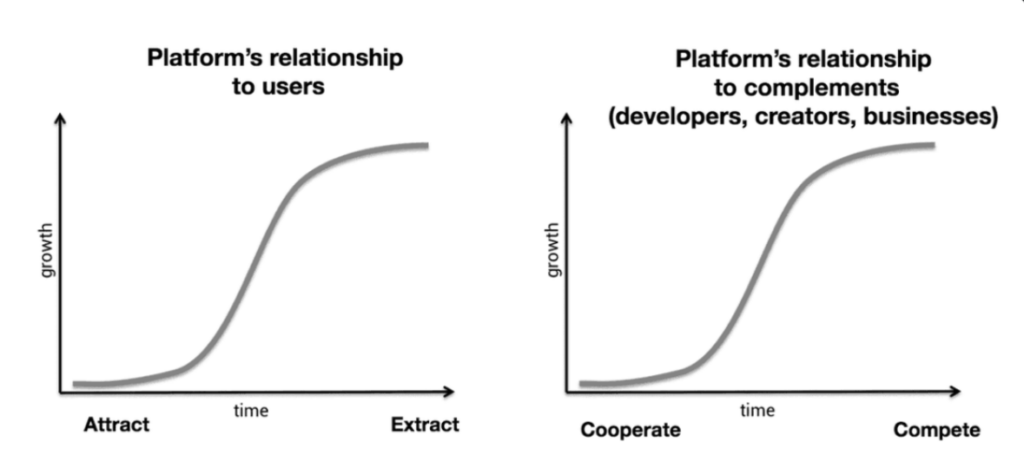
At the beginning, companies focus on attracting users, developers, creators and businesses. They invest heavily in improving the platform, encouraging participation and creating an environment where everyone benefits.
This early stage creates a positive relationship between the platform and its participants. More users attract more creators, more creators attract more users, and the network becomes increasingly valuable.
This is known as the network effect.
However, as platforms become dominant, the relationship can change. Once a company controls a large enough ecosystem, its priorities may shift. Growth becomes more difficult, competition increases and the platform begins looking for new ways to increase revenue.
At this stage, the relationship between the platform and its users can move from cooperation toward competition.
Companies may begin collecting more user data, increasing fees, changing algorithms or introducing products that compete directly with third-party creators and businesses that helped build the ecosystem.
Many technology conflicts have followed this pattern.
Microsoft’s competition with Netscape, Google’s relationship with companies dependent on search traffic, Facebook’s changing relationship with developers and Apple’s disputes with app creators all demonstrate the challenges that arise when a centralized platform becomes too powerful.
For entrepreneurs, developers and investors, this creates uncertainty. Building a business on top of another company’s platform means accepting that the rules can change at any time.
A creator may spend years building an audience only to discover that algorithm changes reduce visibility. A developer may invest millions into an application only to face new restrictions. A business may depend on a platform that later becomes its competitor.
This uncertainty has become one of the major motivations behind the development of Web3.
Web3 and the Return of Digital Ownership
Web3 introduces a different model where ownership and control are distributed among participants.
Instead of users simply accessing services owned by corporations, Web3 allows users and developers to own parts of the networks they participate in.
This ownership is enabled through blockchain technology and digital tokens.
Tokens represent a new way of organizing digital communities. They can provide economic incentives, governance rights, access privileges or proof of ownership.
There are two major categories of tokens: fungible tokens and non-fungible tokens.
Fungible tokens are interchangeable digital assets. Cryptocurrencies such as Ethereum’s ETH function as examples of fungible tokens because every unit has the same value and can be exchanged equally.
Non-fungible tokens, commonly known as NFTs, represent unique digital assets. Unlike cryptocurrencies, each NFT has individual characteristics and ownership records.
NFTs can represent many different types of digital property, including artwork, music, virtual objects, membership rights, digital certificates, gaming items and access privileges.
The important innovation is that ownership exists independently from a single company’s database.
A digital item stored on a blockchain can be verified and transferred without requiring permission from a centralized platform.
This creates entirely new possibilities for digital economies.
Blockchain Networks: The Foundation of Web3 Ownership
Blockchain technology makes Web3 possible by creating decentralized systems that do not depend on a single organization.
A blockchain can be viewed as a global digital infrastructure maintained by a distributed network of computers. Anyone can participate according to the rules of the protocol, but no individual company controls the entire system.
Ethereum is one of the most important examples of this model.
Unlike traditional software platforms, Ethereum is not owned by a corporation. It operates as a decentralized global computer powered by thousands of independent participants.
The network uses its native cryptocurrency, ETH, to secure the system and coordinate activity. ETH is used to process transactions, interact with applications and support the economic incentives that keep the network running.
This creates a new type of digital environment where applications can operate without relying on centralized intermediaries.
Developers can build decentralized applications, users can interact directly with those applications, and ownership records can exist independently of any single company.
How Users Acquire and Earn Digital Assets
One of the important differences between Web3 and previous internet models is that users can participate economically in the networks they help create.
In traditional platforms, users usually generate value for companies without directly sharing ownership of the platform.
Web3 introduces mechanisms that allow communities to receive ownership through tokens.
Users can acquire tokens by purchasing them, but they can also earn them through participation, contribution or creative activity.
A well-known example is decentralized finance platforms that distribute governance tokens to early users. These token distributions reward participants who helped build network activity and encourage long-term community involvement.
Creators can also generate income through digital ownership models.
Artists, musicians, developers and game designers can sell digital assets directly to global audiences without depending entirely on traditional intermediaries.
The rise of NFT marketplaces demonstrated how digital ownership could create new economic opportunities for creators by allowing them to sell unique digital items and maintain connections with their communities.
Tokens as a New Coordination System
One of the most important ideas behind Web3 is that tokens can align the interests of different participants.
In centralized systems, users, developers and platform owners often have different incentives. A company may prioritize revenue growth, while users may want better services and creators may want greater control.
Tokens create the possibility of shared ownership.
When users own part of a network, they benefit from its success. Developers are encouraged to improve the ecosystem because they can also participate in the value they create. Communities can make decisions collectively through decentralized governance systems.
This creates a new economic model where the growth of the network benefits many participants rather than only the company operating the platform.
The goal is not simply to replace corporations with decentralized systems. Instead, Web3 explores whether digital services can be designed in a way where users, builders and communities share ownership and responsibility.
Web3 Combines the Best Ideas of Previous Internet Generations
Before Web3, users faced a difficult choice.
Web1 offered openness and decentralization but lacked the advanced functionality people expect today.
Web2 provided powerful tools, smooth user experiences and global connectivity but introduced centralized control.
Web3 attempts to combine the strengths of both eras.
It aims to preserve the openness of the early internet while adding modern applications, financial systems and digital ownership models.
The technology is still developing, and many challenges remain. Scalability, usability, regulation and security continue to be important areas of research and improvement.
However, the fundamental idea behind Web3 represents a major shift in how people think about the internet.
Instead of viewing users as consumers of digital platforms, Web3 introduces the possibility of users becoming owners and active participants in the networks they use.
The movement is still in its early stages, but it is creating new experiments in digital ownership, online communities and decentralized economies.
The future of the internet may not simply be about accessing information or using online services. It may be about participating in digital ecosystems where the people who create value also have the opportunity to own a part of it.